Policy Brief: How Much Broadband Speed Do You Need? (2020)

Valley Vision, as the managing organization for the Connected Capital Area Broadband Consortium (CCABC), has prepared this policy brief. The CCABC is funded by the California Public Utilities Commission (CPUC) and supports the counties of Sacramento, Sutter, Yolo and Yuba to achieve improved internet connectivity across the region and reduce the Digital Divide.
This policy brief was prepared due to the critical need to expand connectivity, as the pandemic revealed the disparities across the region – connectivity essential for both recovery and an inclusive community. The brief ties together different aspects of internet use from household needs (i.e., speed, usage, multiple users’ needs, and technologies), to larger regional deployment and cost analysis (i.e., broadband coverage by technology and cost to bring internet to unserved households).
Broadband Coverage in the Delta (October 2020)
Beginning in 2014, the Delta Protection Commission (Commission) undertook the Delta Community Action Planning (CAP) project to increase civic vitality and preserve the values and character of historic Delta towns. Through the CAP process, broadband infrastructure was identified as an essential utility needed to serve residents, businesses (including agricultural operations), and visitors. In 2019, Valley Vision completed Connecting the Delta: Broadband Action Plan, a report prepared for the Commission to inform local governments and all those affected by the lack of high-speed internet service of recommended actions to improve broadband adoption and support.
According to the report, within the five legacy communities identified in the CAP project (Clarksburg, Courtland, Hood, Isleton, and Walnut Grove), approximately one-third of households did not have Internet subscriptions at the time of report preparation in 2019. Households and businesses within the legacy communities have very limited provider options. Additionally, 17% of households within Delta communities do not have access to a computing device (desktop, laptop, smartphone, or tablet). Access, quality, reliability, and cost all factor into this circumstance. The Delta is faced with many barriers and has several unserved and underserved areas lacking broadband service, compared to the surrounding greater metropolitan areas of Sacramento, Stockton-Tracy, and the San Francisco Bay Area.
At broadband workshops held in the Delta during 2018 and 2019, community members voiced broadband quality and access frustrations, equity discrepancies, and educational and safety concerns. Additionally, while not exclusive to broadband, it must be noted that each community also identified challenges with mobile wireless (i.e. cell phones) and lack of signal availability.
The 2019 action plan offered three recommendations for achieving improved broadband: (1) organize for action; (2) leverage existing opportunities; and (3) pursue and secure funding. As a preliminary step to organizing for action, the Commission is partnering with Valley Vision and the Connected Capital Area Broadband Consortium (CCABC) to assess the broadband coverage in the five legacy communities and an expanded area including Bethel Island, the Delta Loop, Freeport, Rio Vista, and Terminous.
The following report and maps will be used in three ways:
- To provide local governing bodies, committees, and councils the coverage profiles that broadband service providers have reported to the CPUC,
- To kick off a campaign to engage residents of these Delta communities to test and register their actual residential service download and upload speeds for comparison with the reported available speeds, and
- After reviewing testing results, identify areas where service most needs improvement, and work with the community leaders, appropriate broadband coalitions, Internet service providers and the CPUC to leverage existing opportunities for service improvement and seek funding support.
Health and Life Sciences: Careers in Emergency Medical Services (EMS) & Emergency Technician (EMT)/Paramedic Advisory Report
Sacramento Area Broadband Coverage Maps (CPUC 2019 Data)
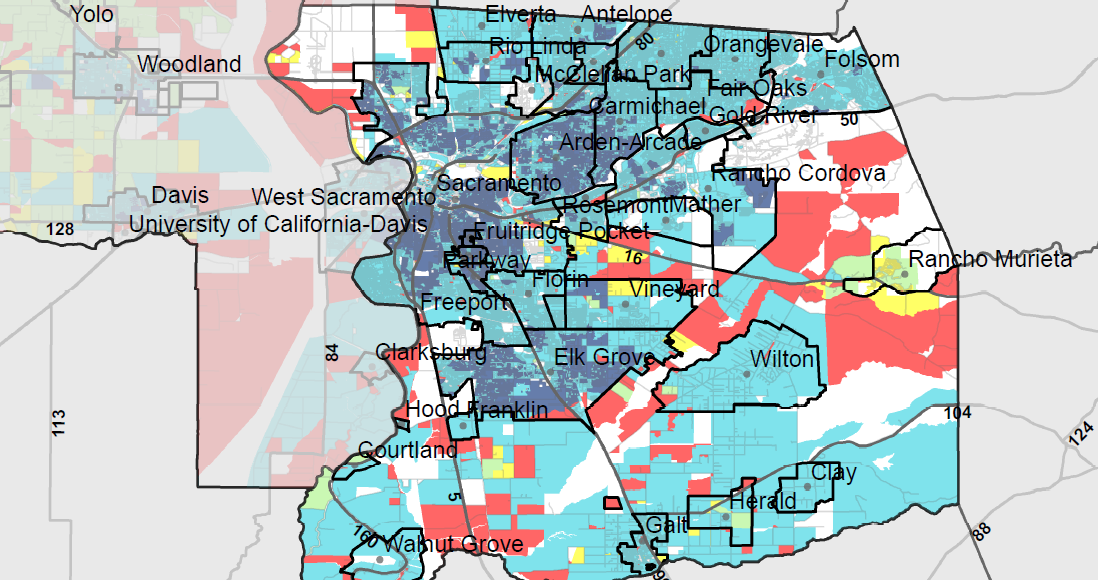
These maps from the CA Public Utilities Commission (CPUC) illustrate broadband coverage across the 4-county Connected Capital Area Broadband Consortium (CCABC) area. The CPUC collects reports from providers throughout the state. More data is available through the agency’s interactive broadband map.
High-Resolution Maps:
- City of Sacramento Broadband Coverage (CPUC 2019 Data)
- City of Sacramento Broadband Coverage – Satellite (CPUC 2019 Data)
- County of Sacramento Broadband Coverage (CPUC 2019 Data)
- County of Sacramento Broadband Coverage – Satellite (CPUC 2019 Data)
- County of Sutter Broadband Coverage (CPUC 2019 Data)
- County of Sutter Broadband Coverage – Satellite (CPUC 2019 Data)
- County of Yolo Broadband Coverage (CPUC 2019 Data)
- County of Yolo Broadband Coverage – Satellite (CPUC 2019 Data)
- County of Yuba Broadband Coverage (CPUC 2019 Data)
- County of Yuba Broadband Coverage – Satellite (CPUC 2019 Data)
Health Sector Regional Advisory Committee Meeting Proceedings Careers in Emergency Medical Services (EMS) & Emergency Technician(EMT)/Parademic
Workforce Needs Assessment: AgTech (2020)
Valley Vision, as part of its mission to support a 21st Century Workforce for the Capital Region, has partnered with the Los Rios Center of Excellence and the California Rice Commission, with support from the state’s Strong Workforce Program, on an analysis of the agriculture technology, or “AgTech” industry cluster.
This report focuses on the impact of technology on a range of occupations in the Food & Agriculture industry cluster, especially related to middle skill jobs, defined as those requiring more than a high school degree and less than a four-year degree.
The Prosperity Strategy: Our Path Forward (2020)

Our Path Forward: The Prosperity Strategy is a strategic framework and bridge to action for the six-county Sacramento Region that prioritizes our core economic initiatives and will result in a more prosperous, equitable and resilient region.
The plan is being advanced by Valley Vision, the Greater Sacramento Economic Council, Sacramento Metropolitan Chamber of Commerce, Sacramento Area Council of Governments, and the Sacramento Asian Pacific Chamber of Commerce. Learn more at https://theprosperitystrategy.org/.
ICT Regional Advisory: Cloud Computing Meeting Proceedings Report
Automation Risk for Jobs in the Capital Region (2020)

Research has clearly shown that technology disruption, like automation, will impact jobs throughout the U.S. Valley Vision worked with the Los Rios Center of Excellence to examine the impact that automation will have on jobs, people, and sectors in the Capital Region. Read the COE and Valley Vision report to learn about the composition of the region’s workforce, the populations that will be impacted by automation, and automation risk across sectors and skill types. This report can help us address as a region how we can prepare for the impending skill shift.
Information and Communication Technologies: Cloud Computing Advisory Report
Broadband Report Card: Map (2020)
Broadband infrastructure grades compare broadband access in a city, town, region, county, or census block to the California average. These maps illustrate the data found in the capital region broadband report card. Click here for grades for each jurisdiction in the Sacramento region.
Steve Blum with Tellus Venture Associates assembled this information on behalf of Valley Vision, as part of the latter’s work in managing the Connected Capital Broadband Consortium (CCABC).
The primary data for assessing the quantity and quality of broadband infrastructure comes from the California Public Utilities Commission (CPUC), which collects reports from providers throughout the state. More data is available through the interactive broadband map produced by the CPUC.
Broadband Report Card: Grades (2020)
Broadband infrastructure grades compare broadband access in a city, town, region, county, or census block to the California average.
Steve Blum with Tellus Venture Associates assembled this information on behalf of Valley Vision, as part of the latter’s work in managing the Connected Capital Broadband Consortium (CCABC).
The primary data for assessing the quantity and quality of broadband infrastructure comes from the California Public Utilities Commission (CPUC), which collects reports from providers throughout the state. More data is available through the interactive broadband map produced by the CPUC.