High Voltage Electrical Careers: Powering Greater Sacramento’s Clean Energy Future

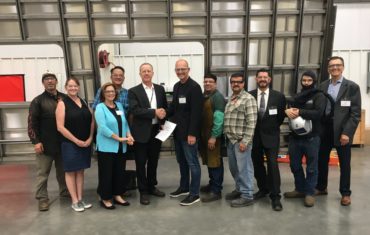
On April 15, 2025, Valley Vision convened a High Voltage Electrical Careers Advisory at Sierra College, bringing together leaders from industry, education, and workforce development to address the urgent demand for skilled high-voltage professionals. With representatives from SMUD, Rivian, the Sacramento Electrical Training Center, CalEPIC and the California Air Resources Board, the hybrid event focused on how these careers are critical to meeting California’s clean energy and zero-emission vehicle (ZEV) goals. The discussion emphasized aligning training programs with industry needs, addressing workforce shortages, and expanding equitable career pathways in one of the fastest-growing sectors of the state’s economy.
California’s clean energy transition has fueled a surge in high-voltage electrical careers. Ebony Benzing, Director of the North/Far North Center of Excellence for Labor Market Research, shared that 416 regional job postings over the past year required high-voltage skills, defined as systems over 600 volts, spanning electricians, maintenance workers, and engineers across utilities, manufacturing, and construction. Of these, 131 positions required a high school diploma or associate’s degree, while 108 required bachelor’s degrees, offering diverse entry points. Employers like SMUD, with 31 postings, and Rivian, with 8, seek candidates with 2 to 6 years of experience, emphasizing skills like transformer diagnostics, safety protocols, and diagnostic software.
Keynote speaker Larry Rillera, Staff Air Pollution Specialist for Community Outreach and Engagement at the California Air Resources Board, emphasized California’s global leadership in ZEV technologies, with electric transportation, a top export, comprising 26% of light-duty vehicle sales and 260 certified heavy-duty ZEVs last year. He outlined the state’s ZEV Market Development Strategy, built on four pillars: vehicles, infrastructure, users, and workforce. Rillera highlighted innovative educational programs in the state, such as Mulholland Middle School’s hydrogen fuel cell car project and Calexico High School’s electrification of a Volkswagen Beetle, which inspire young talent. He stressed modern training methods, like AC Transit’s use of mixed-reality for high-voltage systems, and the need for cross-disciplinary skills in automotive, electrical, and IT fields. Rillera also championed equity, ensuring that underserved communities have access to these career pathways, and projected exponential job growth in ZEV infrastructure, positioning California as a model for sustainable economic development.
High-voltage electrical careers are not only stable and high-paying—they’re central to building California’s clean energy future. With demand rising for roles in EV infrastructure, renewable energy, and grid modernization, Greater Sacramento is emerging as a hub for innovation and global leadership in zero-emission technologies.
Employer panelists representing SMUD, Rivian, CalEPIC, and the Sacramento Electrical Training Center reinforced this demand, and discussed pathways to economic prosperity for workers. SMUD offers apprenticeships starting at $44.70/hour, scaling to $68.26/hour for journeymen, while Rivian’s Fast Track program hires 150 entry-level technicians annually, prioritizing soft skills and in-house training. The Sacramento Electrical Training Center trains 450 apprentices across 17 counties, providing free education for careers with the opportunity to earn over $100,000.
Significant hurdles remain. Outdated training facilities struggle with modern technology, requiring advanced tools such as mixed-reality training, and a looming wave of retirements strains capacity for the future. Benzing pointed out that high-voltage expertise is a competency, not a job title, which is imperative for training alignment. Additionally, many applicants lack foundational skills, such as knowledge of algebra and hand tool use. Equity gaps persist, with underrepresented groups needing better access to training.
The Capital Region can seize these opportunities through strategic collaboration. A comprehensive labor market assessment, as Benzing recommended, alongside employer surveys, will pinpoint high-voltage job needs to align training programs effectively. Strengthening Career Technical Education programs in middle and high schools with hands-on circuit theory, tool use, and job shadowing at substations, such as CalEPIC’s mobile classroom initiative led by Orville Thomas, will prepare students early. Promoting equity through outreach efforts, such as SMUD’s Women in Skilled Trades Day and Sacramento Electrical Training Center’s mentorship programs for women and veterans, will diversify the workforce. Streamlining high school and college curricula to eliminate duplication and offer stackable credentials, from helper certificates to advanced diplomas, will accelerate apprenticeship pathways. Partnerships with Sierra College, unions, and employers like Rivian can expand certifications, such as EVIT for EV charger maintenance, and integrate emerging skills in grid cybersecurity and vehicle-to-grid technology, ensuring a future-ready workforce.
Continued collaboration to unite utilities, manufacturers, educators, and community leaders in a dynamic sector-partnership model allows for co-design of agile curricula, shares innovative resources like mobile labs, and builds a resilient talent pipeline that powers California’s zero-emission ambitions for generations to come. This collective effort will not only fill today’s job vacancies but also empower a diverse workforce to lead in a sustainable, high-tech future. This regional industry advisory was made possible by Strong Workforce Program Funding by the Los Rios Community College District, which brings together industry, employers, education, and workforce stakeholders to align the pathway for these future careers.
For more information on this advisory or previous events, or to share your ideas for a future advisory, please contact DiAngelo Andrews at diangelo.andrews@valleyvision.org. Together, we can power Greater Sacramento’s clean energy economy with a skilled and inclusive workforce!