The Capital Region Achieves a Major Clean Air Standard
We talk a lot about “playing the long game,” but rarely are we around to see the fruits of decades of labor by multiple generations of leaders.
For decades through long-standing partnerships, the Capital region’s leaders, led by our five local air districts – Sacramento Metropolitan Air Quality Management District, Yolo-Solano Air Quality Management District, Placer County Air Pollution Control District, Feather River Air Quality Management District and El Dorado County Air Quality Management District – in collaboration with communities, health nonprofits, environmental advocates and industry representatives, have worked diligently and persistently in cleaning the air for the benefit of all communities.
On August 21, 2025 in Folsom, CA, our local air districts and other regional leaders joined Congresswoman Doris Matsui and former U.S. EPA Region 9 Administrator, Joshua F.W. Cook, to celebrate a major air quality achievement. The Sacramento region met the 2008 8-hour Ozone standard by the 2024 attainment date. Meeting this air quality standard means our communities get to breathe cleaner air and our region will continue to receive federal support and funding. Read the press release here.

The air quality in the Capital region, which includes Yolo, Solano, Yuba, Sutter, Sacramento, Placer, and El Dorado Counties, is geographically impacted by a combination of surrounding mountains, plenty of sunshine, wind patterns and thermal air inversions, making the region dangerously vulnerable to high levels of air pollution. An inversion layer is a layer of warm air trapping cooler air underneath, effectively acting as a lid, trapping pollutants near the ground in the Sacramento valley. Moreover, mountain ranges surrounding the region create a natural barrier, preventing horizontal air movement, which contributes to inversion layers. Meanwhile, the Capital region is one of the fastest-growing regions in the state of California. According to our region’s metropolitan planning organization for land use and transportation, Sacramento Area Council of Governments, the region is projected to add an additional 580,000 residents by the year 2050 (SACOG 2025 Blueprint). Therefore, the Capital region must accommodate population growth through increasing housing production and increasing investments in transportation and utility infrastructure and will have to do so in a way that will also help to manage the challenges that come with rapid growth such as congestion, pollution, and other public service impacts.
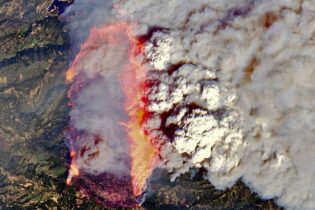
The Capital region’s historical and projected population growth, in combination with its unique topography, will continue to impact air quality, public health and economic growth, especially in our most vulnerable communities. Due to these varying reasons, the Capital region must continue to prioritize and implement strategies and programs that help curb emissions alongside a growing population. If left unregulated, growing emissions from gas and diesel vehicles, heavy equipment that supports multiple industries, including agriculture and logistics and transportation, building and construction, and open burning and wildfire smoke, will endanger millions of people and wildlife and exhaust human and financial resources. For example, air pollution results in significant healthcare costs. Air pollution causes an estimated 107,000 premature deaths annually, and each American pays $2,500 in extra medical costs every year due to air pollution. These numbers contribute to a staggering total of $820 billion in U.S. healthcare costs due to air pollution, according to a report by the Natural Resources Defense Council (Health Costs From Climate Change, 2021). Therefore, it is imperative that the Capital region’s leaders, along with communities, public health non-profits, environmental advocates, and industry representatives, work together to advocate for and implement programs and policies to promote cleaner air, protect community health and advance economic growth. Cleaner air for current and future generations is a responsibility that is shared by leaders and advocates in our region.
The Basics: Ozone Overview and Impacts to Public Health
Ozone molecules are present at both atmospheric and ground-level. Ozone that naturally occurs in the atmosphere serves as a protective layer that shields people from harmful UV rays from the sun. In contrast, ozone at the ground-level, commonly known as smog, is harmful to people and the environment. Ground-level ozone worsens asthma, irritates lungs, and can trigger chest pain, breathing difficulty and cough, particularly for sensitive populations. In our region, ground-level ozone or smog comes from a variety of sources, including gas vehicles, factories, chemical and industrial plants, gas stations and household paints, lawn mowers, barbecues, fire pits and fireplaces, and nearby wildfires. Read more about ground-level ozone basics here.
Guided by the federal Clean Air Act, the Environmental Protection Agency (EPA) is required to set and regularly review air quality standards or National Ambient Air Quality Standards (NAAQS) for five other common criteria air pollutants that are present in outdoor air and are harmful to public health and environment: Carbon Monoxide (CO), Particulate Matter (PM2.5 and PM10), Nitrogen Dioxide (NO2), Lead (Pb), and Sulfur dioxide (SO2).
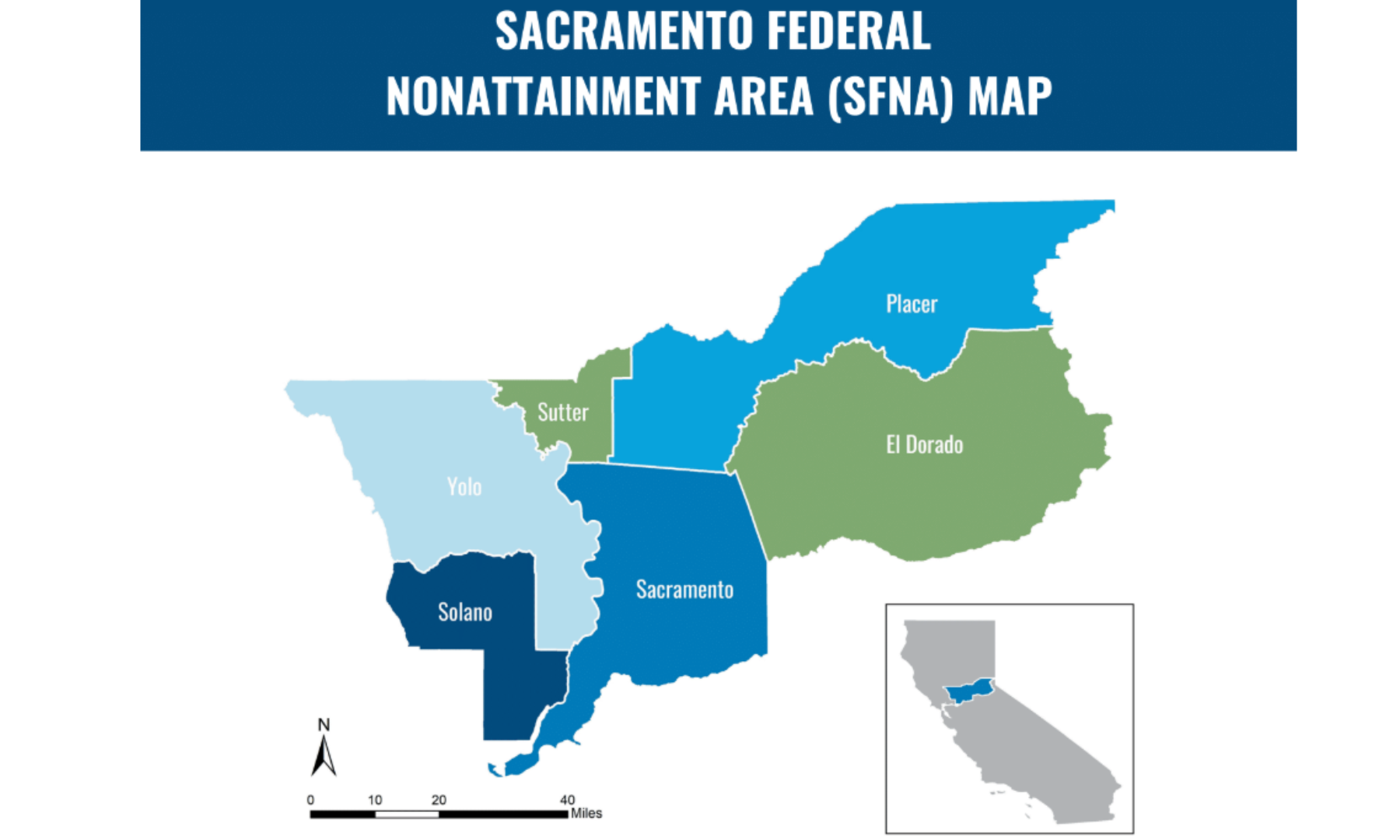
Regions that have been designated “in attainment” by the EPA have levels of these pollutants at or below the national ambient air quality standards. Regions that do not meet the national ambient air quality standards are designated as “nonattainment areas”. The Sacramento region or Sacramento Federal Nonattainment Area (SFNA), which includes all of Sacramento and Yolo counties and portions of Placer, El Dorado, Sutter and Solano counties, was classified as a “severe nonattainment” area for the 1997 8-hour NAAQS of 84 parts per billion (ppb) for ozone. Then again, in 2008, the EPA designated the region as a severe nonattainment area for the revised 8-hour Ozone standard of 75 ppb (Sacramento Metro Air Quality Management District), and was required by the EPA to meet the national standard for ozone by the end of 2024. Due to this designation of nonattainment, the region was at risk of a transportation funding pause and more stringent restrictions for businesses in the region, which would delay our progress in improving air quality, public health and economic growth.
In response, the region’s air districts developed the Sacramento Regional 8-hour Ozone Attainment and Reasonable Further Progress Plan in 2013 to detail how the region would meet the 1997 8-hour standard, which was approved by the EPA in 2015. Then, in 2017, the districts submitted the Sacramento Regional 2008 NAAQS 8-Hour Ozone Attainment and RFP Plan showing how the area would meet the more stringent 2008 ozone standard, which EPA largely approved in 2021. The plans detail how existing and new control strategies would provide the necessary future emission reductions to meet the federal Clean Air Act requirements for reasonable further progress and attainment of the 1997 and 2008 8-hour ozone NAAQS for the Sacramento region, as well as an updated emissions inventory and new motor vehicle emission budgets for transportation. Simply put, the plans document how the air districts and CARB would implement existing and new control strategies to meet the standards by the required deadlines. For example, the plans include strategies to regulate businesses such as industrial facilities or factories and transportation control measures to reduce emissions from on-road and off-road vehicles and equipment. Learn more about the two types of air quality plans that the districts must prepare and update in order to meet and maintain compliance with federal and state air quality standards, here.
Ozone standards are health based standards and achieving them is important to lessen health impacts to our communities. Pollution especially affects seniors, children, pregnant people, individuals with pre-existing health conditions, the unhoused populations, and outdoor workers. As a result, these air pollution impacts from ground-level ozone and the other five criteria air pollutants put further strain on our healthcare systems through increasing hospital visits and care from respiratory and cardiovascular illnesses. Air pollution also disrupts human and natural resource productivity, through crop and ecosystem damage, and increasing the need for infrastructure repair, which impacts local and state resources. According to the EPA, air pollution impacts physical infrastructure through degradation of materials such as concrete and coatings on buildings, bridges, roads, freeways and ports as a consequence of global warming events – more frequent and intense storms, flooding and extreme heat (Climate Change Impacts on Transportation). Attaining standards offers multiple benefits to communities not only through improved air quality and public health outcomes, but also helps businesses avoid additional regulatory requirements, and strengthens eligibility for current and future transportation and infrastructure funding.
Strength in Numbers and Partners: 2008 Ozone Standards Met By 2024 Deadline
“This achievement reflects years of hard work by local communities, businesses, and air agencies, made possible through strong partnerships at all levels of government. While reaching attainment is a proud moment, we’re not stopping here. We remain committed to advancing innovative projects and programs to meet cleaner air quality standards, which will protect our children and hard-working families for generations to come.”
Eric Guerra – California Air Resources Board of Director, Sacramento Region Air Districts

The region’s five local air districts developed plans and implemented strategies that helped our region meet the 2008 8-hour ozone standard for cleaner air and healthier communities. They did this through continuous coordination with agencies including the California Air Resources Board and US Environmental Protection Agency, with local utilities such as SMUD, local non-profit organizations such as Valley Vision and Breathe California-Sacramento, and industry and business leaders such as Teichert, CEMEX, the Sacramento Metro Chamber of Commerce, Sacramento Association of Realtors, and Pacific Gas & Electric through the Cleaner Air Partnership coalition.
Through the Cleaner Air Partnership coalition, decades of advocacy, outreach and education have contributed to cleaner air and healthier communities in our region. Most notably, the Cleaner Air Partnership coalition helped require the Bay Area to conduct enhanced smog checks on vehicles, as our air quality was impacted by pollution blowing in from the west. The coalition also helped to advocate for the successful inclusion of the South Sacramento-Florin community as an Assembly Bill (AB) 617 community, which opened the door for the community to receive funding and resources for emissions reduction. Today, the coalition continues to provide outreach and education on air quality-related topics such as transportation emissions reduction strategies and actively participates in federal advocacy through the Sacramento Metro Chamber’s annual Capitol-to-Capitol program. It is key to note the contributions of the business community for investing in clean innovations and strategies, for example in complying with local, state and federal regulations such as transitioning their fleets to zero-emissions. Moreover, it is also crucial to recognize the contributions of communities, especially low-income and communities of color, who have prioritized and supported clean alternative transportation and other key emissions reduction strategies such as advocating for expanding tree canopy, advocating for protected bike and pedestrian lanes, and actively taking part in learning more about air quality and public health education.
Keeping Up Momentum: The Work Doesn’t Stop Here
The Capital region’s geography due to its unique combination of surrounding mountains, lots of sunshine, varying wind patterns, and thermal air inversions, along with a fast population growth and changing climate will continue to impact air quality, especially in polluted communities. While the region has achieved a significant milestone by meeting the 2008 ozone standard, the work can’t stop. The Capital Region’s air districts, along with our communities, various public partner agencies, organizations and businesses must continue to be creative and find innovative solutions to meet air quality standards, including the newest most stringent ozone standard of 70 ppb that was set in 2015. Investments in policies and programs that sustainably fund clean infrastructure in both the natural and built environment, strengthen public-private partnerships, and cultivate intentional and genuine community engagement and education is imperative to our region’s progress. With federal funding cuts to environmental justice and air quality programs, it is now more important than ever that the region’s leaders, including state and federal level agencies and departments, continue to work together to ensure cleaner air for the benefit of all of our communities.
The Cleaner Air Partnership looks forward to continuing our advocacy and advancing this important work at the local, regional, state, and federal levels on behalf of all communities in the Capital Region. Learn more about Cleaner Air Partnership here to get involved and stay up to date.